
The Trans-Pacific Journey of Stainless Steel Railcar Technology
In 2027, Cleveland will retire a fleet of Japanese-built stainless steel rapid-transit cars that has served the city for more than four decades. Known as the Airporter II, these cars entered service on the GCRTA (Greater Cleveland Regional Transit Authority) Red Line in 1984, linking downtown Cleveland with Cleveland Hopkins International Airport.
The Airporter II was not a glamorous long-distance train or an exotic prototype. Yet its corrugated stainless steel body carries a layered story of industrial and technical exchange between Japan and the United States. It represents an era when Japanese builders entered, and often struggled in the North American market. More broadly, it traces a technological journey in which stainless steel railcar construction developed in the United States, matured in Japan, and eventually returned to America.
That story begins in Philadelphia in the 1930s.
Budd and the Birth of Modern Stainless-Steel Trains
To understand the Airporter II and the wider history of stainless steel railcars, one must start with the Budd Company, one of the great names in American railroad history. Founded in Philadelphia in 1912, Budd first became prominent as a pioneer of metalworking for the automotive industry. During the 1930s, it developed welding methods for stainless steel alloys; materials notoriously difficult to fabricate, and secured numerous patents.
Stainless steel is an alloy based primarily on iron, with chromium, nickel, and other elements added to improve resistance to corrosion and rust. Its invention and practical development largely took place in the 1910s. It solved iron’s vulnerability to rust and corrosion, but it brought new problems: it was difficult to work, and conventional welding techniques would severely damage its corrosion resistance characteristics and ruin its shiny appearance.
As a pioneer in metal fabrication technology, Budd carried out extensive research on methods of joining stainless steel under a variety of conditions, culminating in the development of Shotwelding. As a new form of resistance spot welding, Shotwelding retained corrosion resistance of stainless steel while also being suitable for mass production. The process offered major advantages over conventional riveted construction in weight, strength, and manufacturing efficiency. Protected by patents, it became one of Budd’s most decisive competitive advantages.
Having developed Shotwelding, Budd applied the technology to a variety of its products and offerings. In addition to its established core business of railroad equipment, Budd also expanded into marine, aviation, and military applications. In 1931, Budd built and flew the BB-1 Pioneer, an experimental stainless steel flying boat. In 1943, Budd produced the RB-1 Conestoga transport aircraft for the U.S. Navy. During World War II, Budd also worked on components and structures for naval vessels, broadly exploring the possibilities of stainless steel fabrication.
Railcars, however, were where stainless steel technology truly flourished. Budd achieved national prominence with the Pioneer Zephyr, the high-speed luxury streamliner introduced in 1934. From long-distance passenger trains to commuter railcars, Budd became the defining American manufacturer of stainless steel railroad equipment in the twentieth century.
Budd’s stainless steel railcars, silver in appearance, featured fluted corrugated panels. The corrugations were not merely decorative. They reduced distortion in thin stainless steel sheet metal and helped Budd mass-produce lightweight bodies with adequate structural strength. Budd’s success later spread abroad through exported railcars, manufacturing licenses, and technical partnerships.
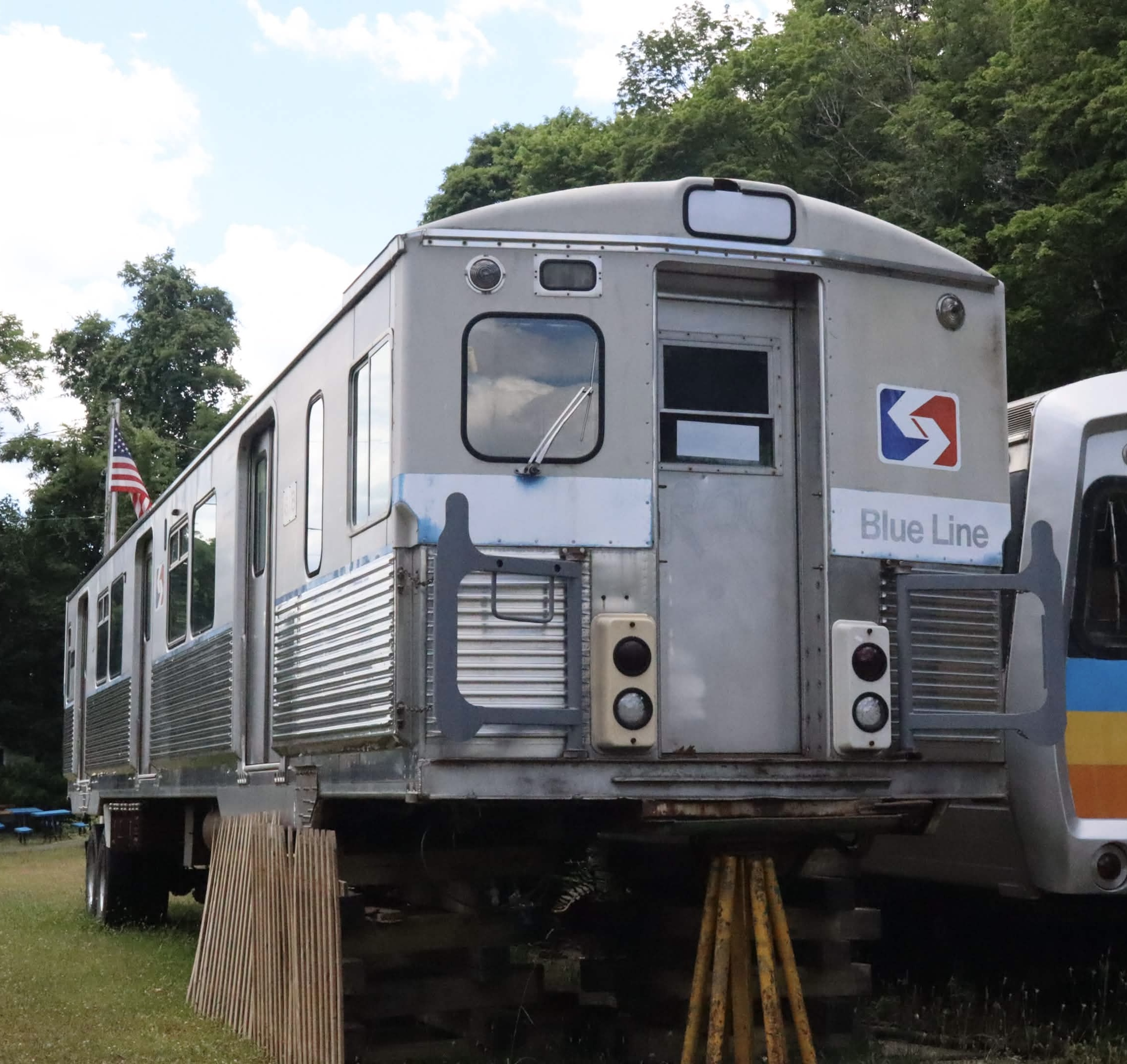
Budd SEPTA M-3 EMU
© 9151 Creations – CC BY – SA 4.0
Tokyu Car Enters the Story
Japan, meanwhile, was struggling through the chaos of the postwar reorganization and reconstruction. Tokyu, a major commuter and regional railroad in southern Tokyo, founded its Yokohama Works on the site of a former Imperial Japanese Navy arsenal in Kanazawa Ward, Yokohama. This was a period when the American occupation authorities, acting under newly introduced anti-trust laws, reversed the wartime mergers of numerous transit systems in Tokyo that had formed the “Greater Tokyu” giant. The surviving corporate entity, the Tokyu Electric Railway, was returned to its pre-merger size with a smaller rail network. Tokyu Yokohama Works was created to repair and restore the many railcars damaged during the war, and in 1953 it was renamed Tokyu Car Corporation.
To compete with older and more established railcar manufacturers, Tokyu Car aggressively pursued new technologies and new markets. In 1956, Tokyu Car president Riji Yoshitsugu traveled through North and South America to investigate and develop export opportunities. There he encountered Budd’s newest stainless steel railcars. In a later roundtable discussion, Yoshitsugu recalled:
> “Everywhere I went in South America, people would say, ‘We buy these superb railcars from the United States. Why don’t you hop on board for a ride?’ In Brazil I rode in an all-stainless-steel Budd car. It was wonderful. I had gone there to promote our products, but instead I found myself admiring the trains from another country wherever I went.”
— *Railway Pictorial*, No. 696, p. 67, Denkisha Kenkyukai
Tokyu Car subsequently developed its own stainless steel prototypes, which entered service as the Tokyu 5200 and 6000 series. These were “semi-stainless” cars: stainless steel was used for the outer skin, while conventional steel remained in the structural framework. Even before the semi-stainless cars entered service, Tokyu Car had set its sights on the more demanding goal of a fully stainless steel railcar. Naturally, Tokyu turned to Budd for help. The two railcar manufacturers would reach an agreement in 1958, and signed a formal contract on December 15, 1959. In 1960, Budd engineers, production equipment, and American-made stainless steel materials arrived in Japan. At Tokyu’s Yokohama plant, a new dedicated all-stainless steel production line was established under Budd’s direction. Tokyu Car learned not only Shotwelding, but the entire American system of railcar production: drafting methods, bill-of-material preparation, material procurement, detailed structural calculations, and more.
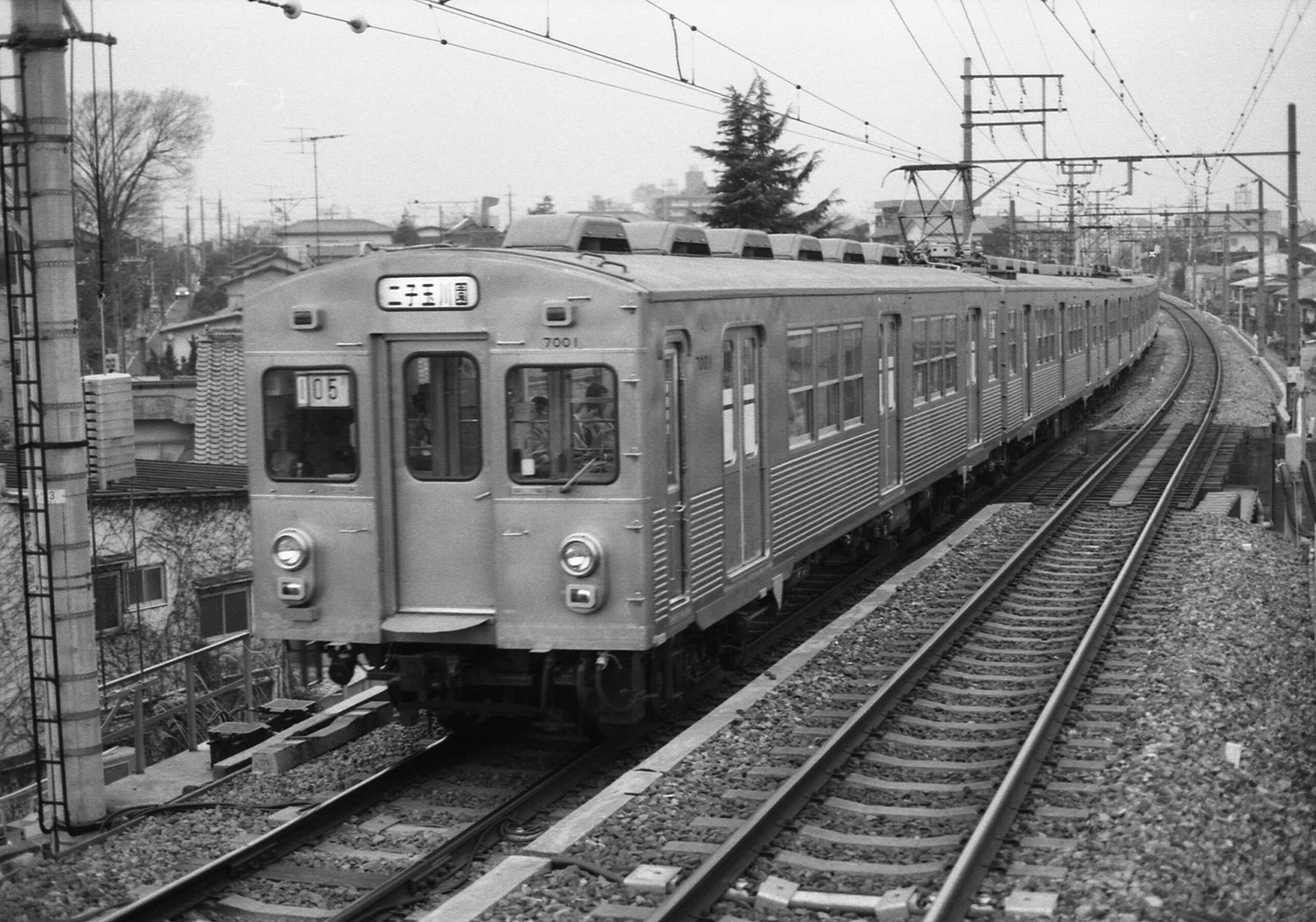
The Budd/Tokyu 7000 series ― Japan’s first all stainless steel railcar
© Hahifuheho – Public Domain
The result was Japan’s first all-stainless steel railcar, the Tokyu 7000 series of 1962. Built under Budd’s close supervision, it was effectively an American train constructed in Japan. It closely resembled the M-3 cars then being built by Budd for SEPTA (Southeastern Pennsylvania Transportation Authority), but it marked a solid and important beginning for Japan’s stainless steel railcar industry.
Tokyu Car later developed its own independently designed stainless steel cars, including the Tokyu 8000 series, and went on to work on the next generation of lightweight stainless steel car bodies. Budd’s stainless steel technology was carefully passed on from America to Japan, where it was further developed and improved. With support from the former Japanese National Railways, Tokyu’s stainless steel technology would later proliferate to other Japanese railcar manufacturers. Before long, the silver commuter train became an inseparable part of the urban landscape throughout Japan.
Cleveland and the Airport Link
Now let us turn to Cleveland.
The GCRTA Red Line is a rapid-transit route that opened in 1955 and was extended to Cleveland Hopkins International Airport in 1968. As America’s first major airport rail link, the line relied on two types of cars: the older, short steel-bodied “Blue Bird” cars that had served since the line first commenced service, and the larger, more modern Pullman-built stainless steel cars known as the “Airporter,” introduced in conjunction with the airport extension.
The Airporter II procurement program was intended to replace both the aging Blue Birds and the still relatively young Airporter fleet at once, creating a standardized fleet. The order totaled 60 cars: 20 double-ended cars, numbered 181 through 200, and 40 single-ended cars, numbered 301 through 340. The fleet thus comprised two subseries: double-ended 180-series cars and single-ended 300-series cars. Both types carried up to 230 passengers. The double-ended cars seated 80, while the single-ended cars seated 84.
Every car was self propelled and motorized. They used all-stainless steel bodies with the corrugated construction inherited from Budd. At roughly 76 feet long and 10 feet wide, they were larger than conventional Japanese commuter cars but smaller than Shinkansen cars. They ran on standard-gauge track with 600-volt DC overhead electrification, and had a top operating speed of 59 mph. Unlike the LRVs common in many small and mid-sized North American cities, the Airporter II was a full-sized, high-floor rapid-transit car.
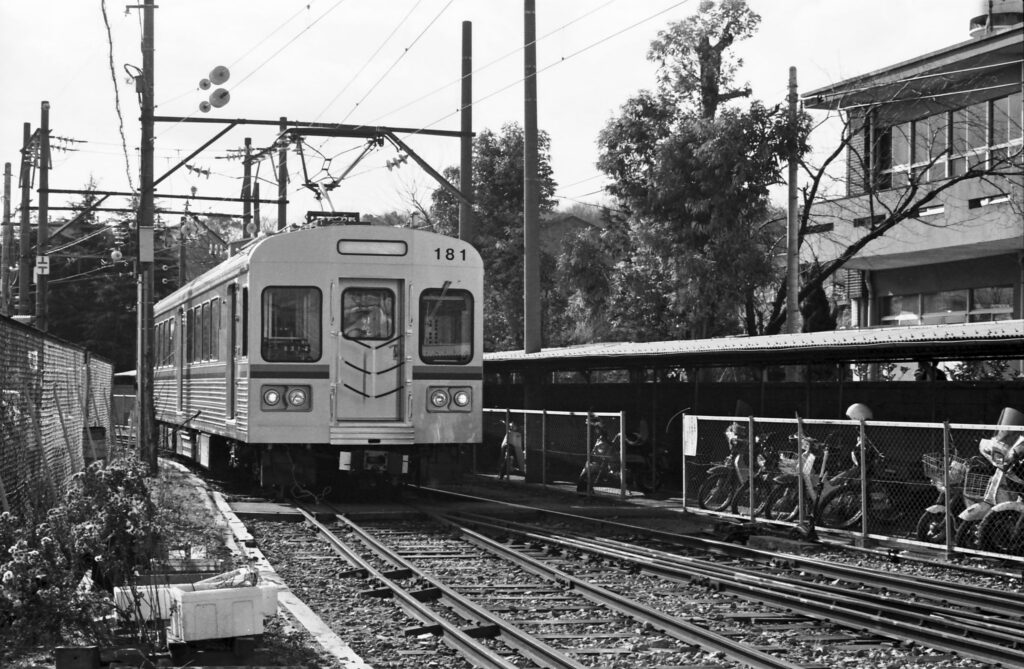
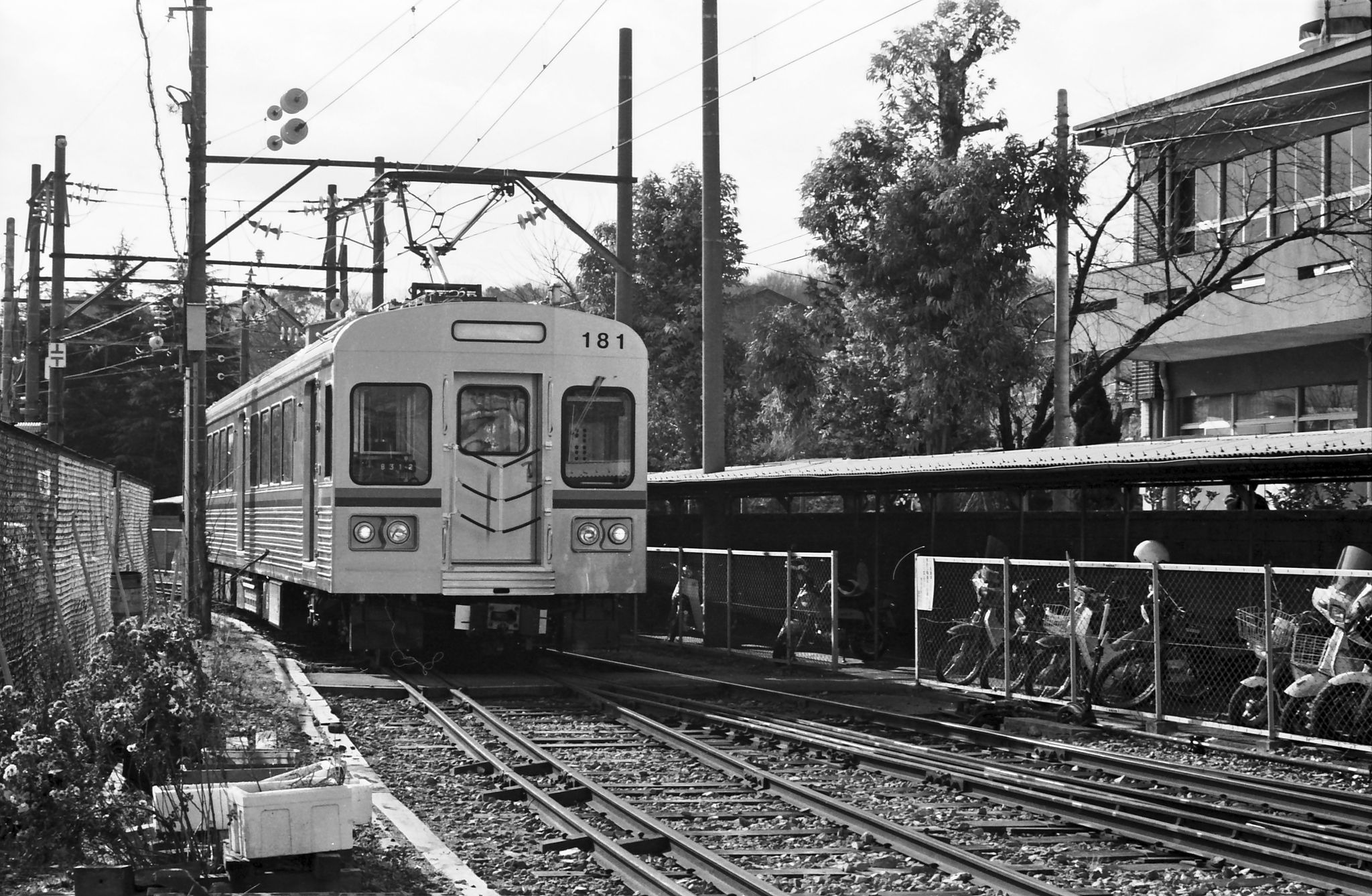
Airporter II undergoing early testing in Yokohama ― note the dual gauge track
© Masahiko Horikawa – Used with Permission
A Japanese Train for an American Railway
Although built by a Japanese manufacturer, the Airporter II was strongly influenced by American practice in its body design, trucks, pantograph, controls, and air-conditioning equipment.
The car body used the all-stainless construction Tokyu Car had learned from Budd and then further refined in Japan. Its silver, fluted exterior gave it an unmistakably American appearance. The trucks used an inside-bearing arrangement common in the United States but unusual in Japan.
To meet federal Buy America requirements, GCRTA specified the use of American-made major components, including electrical, braking, and air-conditioning equipment. For propulsion control, Tokyu initially proposed the chopper-control equipment it had used on Buffalo’s LRVs. After discussions with GCRTA, however, the project reverted to the more conservative choice of GE-supplied resistance control. This was the same system used on the legacy Bluebird and Airporter cars, and would ease the fleet transition for maintenance staff.
By the time the Airporter II cars were being built, Japan had already begun introducing a newer generation of trains. The next generation lightweight stainless steel rails lacked corrugation, and the propulsion was achieved using AC motors and advanced VVVF inverters. By Japanese standards of the early 1980s, the Airporter II’s corrugated body and resistance controls looked conservative—if not already old-fashioned and outdated. However, it is important to consider the historical context surrounding these seemingly outdated design choices. Tokyu had been a major supplier to Boeing’s troubled Standard LRV program and had firsthand experience with the risks of introducing unproven complexity into North American transit vehicles. In that context, the Airporter II’s conservative specifications appear less like a technical limitation but rather a deliberate engineering choice. In retrospect, that decision appears justified: the Airporter IIs have remained in service for more than 40 years, and have demonstrated impressive reliability.
From the Japanese perspective, one of the Airporter II’s more distinctive features was its American-style air-conditioning system. Compressors and condensers were mounted beneath the floor, while evaporators were located at each upper corner inside the car body. This distributed system was designed for fully automatic heating and cooling control. Although common in Europe and North America, it was highly unusual in Japan. Sanemitsu Toki, a senior Tokyu Car executive who was deeply involved in the Airporter II project, later recalled that because the roof did not need large openings for air-conditioning units, “the exterior appearance was kept very clean and smart.” While split air-conditioning systems have gradually become more commonplace on Japanese express and HSR trains, they are still highly unusual for commuter and suburban trains. Examples include the unpowered cars of JR West’s 223-1000 series and JR Hokkaido’s 731 series.
Apart from those American-derived technical elements, however, the Airporter II looks strikingly Japanese. Although the all-stainless construction originated in the United States, the stainless steel itself used to build the Airporter II was Japanese-made SUS301. GCRTA’s original specification had called for American-made SUS201, but Tokyu Car successfully pressed to use Japanese SUS301 instead. Its nearly rectangular cross-section, flat ends, symmetrical front, and three pairs of double-leaf doors per side all reflect familiar Japanese commuter-train practice. Trains with similar proportions and configurations are ubiquitous in Japan.
Many American urban railcars use a trapezoidal body profile to allow for vehicle sway within the loading gauge. The Airporter II, however, used a near-rectangular cross-section, similar to Japanese practice. This made the cars seem even more Japanese. Its plain stainless steel front had modestly angled three-panel ends, a horizontal row of headlights and marker lights, and a colored line stripe running across the face. It strongly resembled Japanese commuter and subway equipment, particularly the original appearance of Tokyo Metro’s former 5000 series and the Tokyu 8090 series, also built at the Yokohama plant during the same period. Thus, even as it used American components and operated in America, the Tokyu-built Cleveland train looked unmistakably Japanese at first glance.
The driver’s cab incorporated a desk-style console closely resembling those found on Japanese commuter trains. The main controller was a left-hand, one-handle master controller. Its operation was the opposite from normal Japanese practice: pulling the handle back applied braking, while pushing it forward applied power, following American convention. A fare-collection window was also provided between the cab and passenger compartment for one-person operation.
The left-hand cab is particularly revealing. American railway vehicles traditionally place the engineer on the right, partly because trains generally operate right-handed and signals are commonly positioned on the right side of the track. Some American equipment—including the original BART fleet and Metro-North’s M-1 and M-2 EMUs—even used asymmetrical front ends with a forward-view windshield only on the right.
The Airporter II, despite being built for Cleveland, placed its operator on the left, just as Japanese commuter trains do. This was not simply a Japanese convention imposed on an American customer. The Red Line is largely a double-track railway with island platforms. On a right-hand-running line, those platforms lie to the operator’s left in the direction of travel. Since one-person operation requires the operator to observe the platform and control the doors, a left-side cab reduces the workload. The arrangement was therefore a practical response to Cleveland’s infrastructure and operating method; its resemblance to Japanese practice was coincidental.
The passenger compartment was designed with airport access in mind. It was spacious and brightly finished, using extensive fiberglass panels and a simple, clean interior design. Rather than maximizing standing-room capacity in the manner of a typical commuter train, the layout emphasized passenger comfort. Most seating consisted of fixed two-person transverse seats. The seat orientation reversed across the center doorway, producing an outward-facing layout. Large luggage racks were also provided for airport passengers.
American commuter railcars normally require substantial crashworthiness provisions to protect against possible collisions with heavy freight trains. They must meet strict FRA (Federal Railroad Administration) regulations and AAR (Association of American Railroads) standards, including high end-compression-load requirements. The GCRTA Red Line, however, is an entirely self-contained urban railway with no connection to the national railroad network. It could therefore be designed to less demanding crashworthiness standards than conventional American mainline rail equipment. Freed from the strict rules that apply to the U.S. general railroad system, Tokyu Car was able to apply many design approaches familiar from Japanese commuter trains.
The Airporter II was neither wholly American nor wholly Japanese in conception. Its stainless-steel body traced its ancestry to Budd; its detailed form reflected Tokyu Car’s Japanese experience; and its cab arrangement, components, and operating practices answered the specific needs of Cleveland’s Red Line. That combination makes the cars more than an unusual export order. They are a surviving record of how railway technology crossed the Pacific, changed in the process, and returned in a new form.
Part Two follows Tokyu Car’s attempt to enter the North American market, the Airporter II’s export and local assembly, and the fleet’s final chapter as Cleveland introduces its replacement cars.