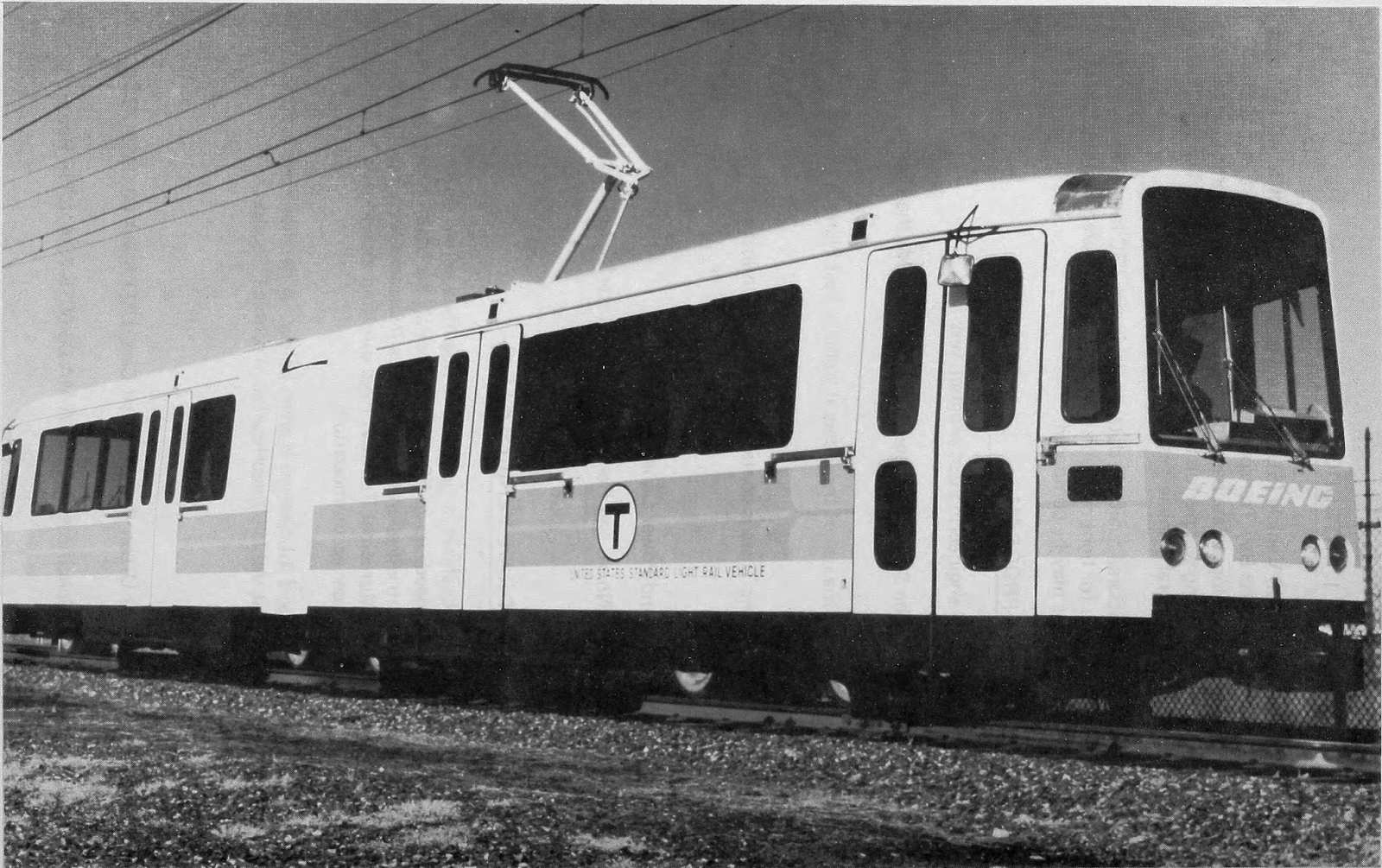
The Boeing standard LRV made a spectacular debut, proudly displaying “UNITED STATES STANDARD LIGHT RAIL VEHICLE” on its body.
Copyright: USDOT Public Domain
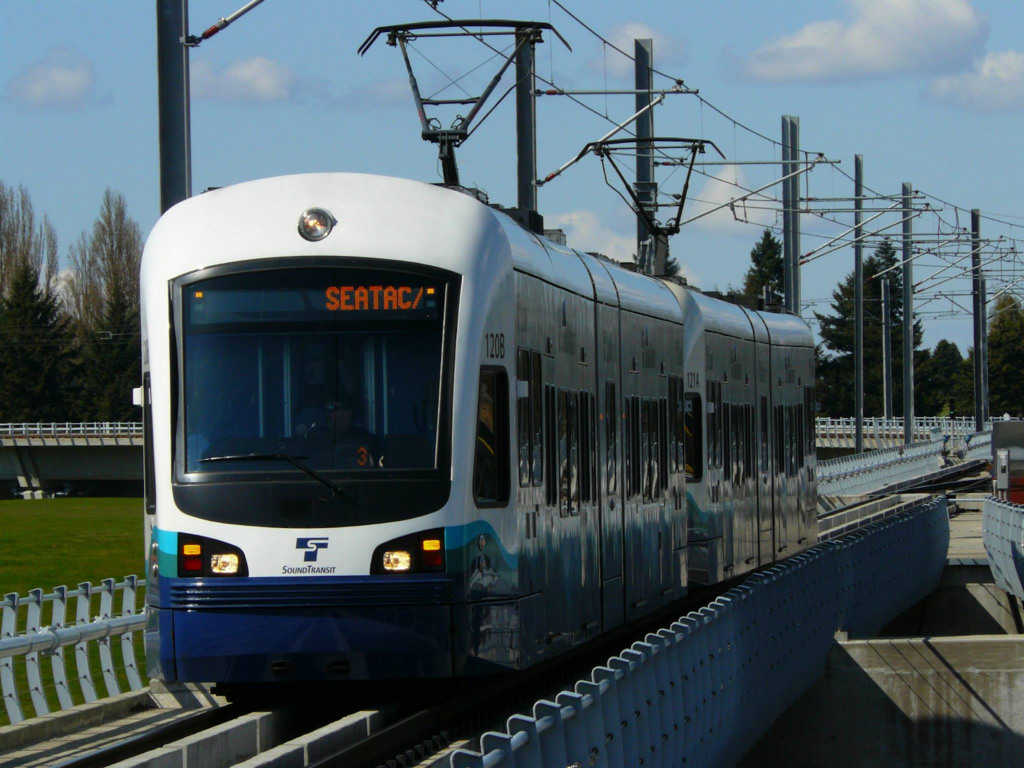
Over the past several decades, Light Rail systems have gradually become a familiar sight across the United States. They are generally standardized, as they all use catenary systems, and the vehicles typically measure about just shy of 9 ft wide and 70-80 ft long. They are almost certainly articulated, with either two sections on a high-floor design or three sections on a partial low-floor design, and they carry electric couplers at both ends, allowing multiple units to be easily coupled and operated together as a single train. That, in simple terms, is the standard profile of an American LRV.
At one point, this market was fiercely competitive. Japanese builders like Nippon Sharyo and Kawasaki Heavy Industries, Italy’s Breda, and Canada’s Bombardier all fought for orders. In recent years however, the market has settled into a duopoly between Siemens and Kinki Sharyo. Even though the builders may differ, standardized specifications mean that LRVs in Seattle look much the same as ones in Dallas or Phoenix. You could call it monotonous, but there is no question that standardization and common specifications helped cut costs and played a major role in bringing rail transit back to American cities.
Behind this current landscape lies an earlier attempt at a federally standardized Light Rail Vehicle that ended in a spectacular disaster. The Boeing Standard Light Rail Vehicle, which was conceived as a landmark project by the federal government and built by one of the world’s industrial giants. While it did lay some of the groundwork for the later light rail boom, it was widely disliked by operators and passengers alike, branded a failure, and ultimately consigned to the shadows of history. It was an LRV born from a major national project in which Japan was also deeply involved. In this article, we trace the little‑known story of that ill‑fated Light Rail Vehicle.
Standard LRV concept
In the late 1960s, while highway expansion and motorization swept across the United States, streetcar networks in many cities were being dismantled. Even in places where they barely survived, the once-dominant PCC cars were approaching the end of their useful lives. At the same time, the winding down of the Vietnam War raised another concern: a looming economic blow to the defense industry from reduced demand. Faced with both a collapsing urban transit sector and the prospect of a postwar slump in the defense industry, the federal government sought a solution that could address both problems at once.
The “US Standard Light Rail Vehicle” (LRV) was envisioned as a creative solution to both of those looming problems. Backed by the newly established Urban Mass Transportation Administration (UMTA) — later renamed the Federal Transit Administration (FTA), the project aimed to unify the fragmented vehicle procurement process of the various local transit agencies while also supporting the nation’s defense industry. The goal was to deliver a modern, standardized rail car compatible with existing urban rail systems in cities such as Boston, San Francisco, and Philadelphia. Much like the earlier PCC cars, standardization was intended to lower costs and revive declining American urban transit using the advanced engineering might of the nation’s defense industry.
The company chosen to design and manufacture the new cars was Boeing Vertol. In Japan, Kawasaki Heavy Industries had been building the Boeing V-107 helicopter under license as the Kawasaki KV-107 for the Self-Defense Forces and Swedish military, making Boeing a familiar name there too. In 1973, Boeing officially won the federal contract to build the Standard LRV — a welcome development for both the nation’s struggling transit agencies as well as for Boeing. Thus, the Boeing Standard LRV emerged both as the spiritual successor to the PCC cars, as well as a symbol of a new chapter in which a major aerospace firm would step into the world of urban transit.
The vehicle concept was highly ambitious for its time. In developing the Standard LRV’s specifications, UMTA gathered transit agencies from across North America (including Canada), along with domestic and international manufacturers and consultants. The resulting design called for a high-floor, articulated car about 70 ft in length, with driver’s cabs at both ends and three trucks (six axles) — a true full-featured Light Rail design. Larger than the single-body PCC cars, it had three doors on each side to improve passenger flow and shorten dwell times. The plan envisioned a next-generation, versatile railcar capable of operating on street trackage, exclusive rights-of-way, and even in subway tunnels. Initial orders called for 150 units for Boston and 80 for San Francisco, with further expansion to other U.S. cities expected to follow.
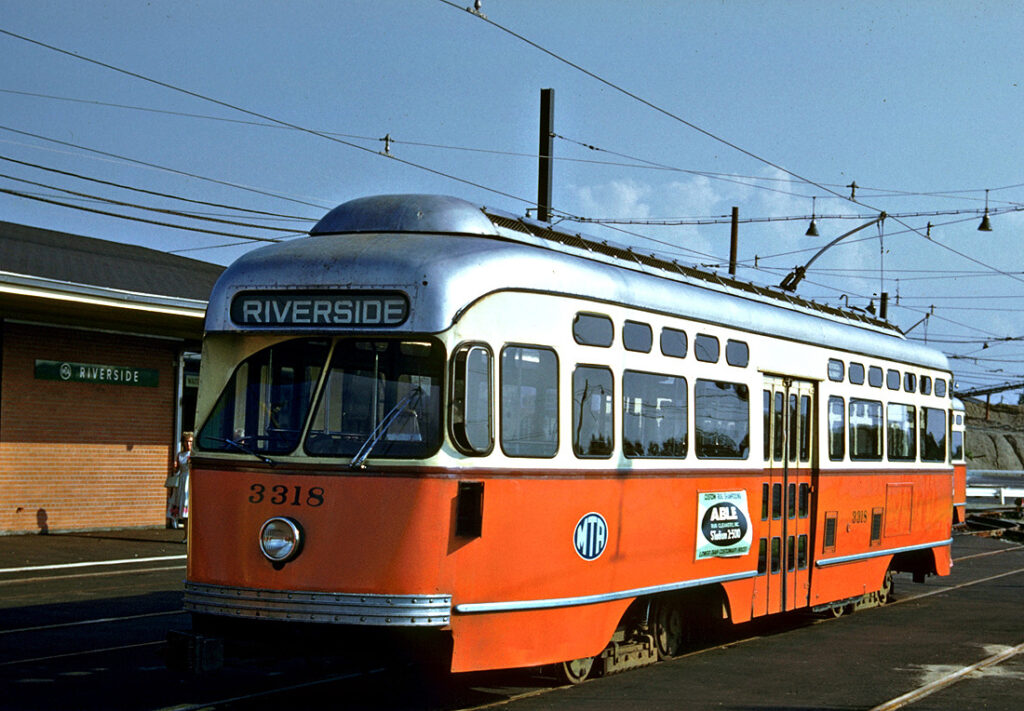
The PCC cars that were supposed to be replaced by Boeing standard LRVs
Copyright information: Voogd075 at Dutch Wikipedia • CC BY-SA 3.0
The visual appearance of the Boeing Standard LRV itself reflected the spirit and expectations of its era. Its angular, modern body looked somewhat rugged, yet it embodied the kind of futuristic urban transit that Americans in the 1970s imagined. Unlike the curved, graceful lines of the classic PCC cars, this was a new face of urban rail — one designed for an age of standardization and mass transportation.
Interestingly, even the term “Light Rail” was newly coined just then in America. In 1972, the UMTA adopted “Light Rail” as an official language to describe an American version of the modernized, higher-speed tram systems that was beginning to take shape in Europe, particularly Germany’s Stadtbahn-type urban railways. Accordingly, the standardized vehicle program was named the “United States Standard Light Rail Vehicle”. Behind the ambitious technical specifications lay UMTA’s broader vision: rather than simply introducing new cars onto aging streetcar lines, the goal was to separate key routes from the existing network, and to upgrade them into faster, higher-capacity corridors that would extend into the suburbs.
Standardization gone wrong
While the U.S. Standard LRV project began with grand ambitions, transforming that idea into reality proved difficult, and the plan soon began to lose focus. The main problem was that the UMTA tried to force two fundamentally different sets of requirements, from Boston and San Francisco, into a single standard design.
In Boston, the Massachusetts Bay Transportation Authority (MBTA) needed cars capable of navigating the sharp curves in its 19th century tunnels. To manage this, the car bodies had to taper significantly toward the ends. As a result, large gaps appeared between the end doors and the station platforms, though this wasn’t a major issue in Boston, where stations all had low platforms.
San Francisco’s Municipal Railway (MUNI), however, operated a mixed network that included both street-level stops with low platforms and underground stations with high platforms. On the high platforms, the wide gaps at the car ends were considered hazardous, forcing the end doors to remain closed at those stations. Riders would simply have to remember that at certain stations they must board or exit only through the two center doors. From the start, it was clear that this arrangement would generate serious confusion among riders.
Design and Manufacturing
As stated earlier, Boeing’s Standard LRV was built under a scheme in which UMTA defined the basic specifications, and Boeing would handle the overall design and final assembly at its Ridley Park plant in Pennsylvania. The core vehicle components; the car body shells and truck frames were manufactured by Tokyu Car in Yokohama, Japan, and the traction motors and chopper control equipment were supplied by Garrett. Firms from Germany and the United Kingdom also took part in supplying components for this project.
Several factors lay behind this high degree of international collaboration. In addition to Boeing’s lack of experience in building rail cars, streetcar production in the United States had ceased in 1952. This hiatus had seriously weakened the domestic supply base for related components. Although the Boeing Standard LRV was conceived as an all-American project to create a standard light rail vehicle, its realization depended heavily on foreign railway engineering and manufacturing capabilities, particularly from Japan. Although it would be going too far to call the Boeing LRV a Japanese-built rail car, Japan’s share of the project far exceeded that of any other foreign partner.
A quick side note: numerous online sources claim that the truck design of the Boeing Standard LRV adopted the design of the truck frame and air-bag-suspension system of the Japanese High-Speed-Rail Shinkansen Series 0. However, this claim stands on shaky ground. It is true that Tokyu Car’s Yokohama plant, which built the Boeing LRV’s truck frames and carbody, also manufactured Shinkansen Series 0 trains for the former Japanese National Railways (JNR), and it is natural to think that cutting-edge air-bag-suspension technology used on the Series 0 would be adopted in support of the Boeing LRV.
However, it’s a different story when it comes to the truck frame itself. The trucks of the Shinkansen Series 0 and those of the Boeing Standard LRV differ fundamentally not only in wheelbase and wheel diameter, but also in the structure of the frame. The Series 0 uses an outside frame design, while the Boeing LRV uses an inside frame design, making direct adoption unlikely. When referencing the January 1976 issue of Popular Science, often cited as the source for this claim…
“The Boeing trolley has a new design truck and air-bag-suspension system that’s adapted from the Japanese Bullet trains”
The misunderstanding appears to stem from this sentence. The author of the article was most likely referring to the newly designed truck and to the air-bag-suspension system derived from the Shinkansen separately, but the phrase “adapted from the Japanese Bullet trains” seems to have been misread as applying to the truck as well.
To make up for the delays in the project, testing and evaluation proceeded in parallel with early production. By late 1974, the first prototype car had made its initial run on the test track within the final assembly site, and in 1975 the completed prototype was sent to the MBTA for three months of on-site trials. After that, three pre-production cars — two built to MUNI specs and one to MBTA specs — were shipped to the Transportation Technology Center in Pueblo, Colorado, where a joint team from Boeing and the USDOT carried out tests on the Transit Test Track (TTT). This TTT facility was developed by UMTA in the early 1970s and was originally electrified with a third-rail system for subway car testing, but as part of the Boeing Standard LRV trials, overhead electrification was added as well.
During testing, data on ride quality, noise, electromagnetic interference, and other performance characteristics were gathered. Such testing took place in parallel at Pueblo, the Boeing plant, and in San Francisco as well as Boston. The data gathered during the test campaign were deemed satisfactory at the time.
Later in 1976, car 3401, an MBTA unit, was also tested in Cleveland, Ohio, on the right-of-way of a former interurban line, but the Greater Cleveland Regional Transit Authority (GCRTA) declined Boeing’s sales pitch. The following year, in 1977, GCRTA held an open tender for the introduction of LRVs; Boeing submitted a bid, but lost to Breda and never secured an order.
The disastrous rollout
Revenue service in Boston began on December 30, 1976, but serious problems emerged almost immediately. Nearly every major component, including the doors, air conditioning, and electrical equipment and propulsion system proved unreliable. The frequent derailments in particular proved so problematic that, just three months after the start of service, all cars were temporarily withdrawn on April 16, 1977.
Aside from the frequent derailments, one of the most troublesome features was the early plug doors. Unlike the simpler doors used on older PCC cars, these doors were needlessly complex, which led to frequent malfunctions. The underfloor air-conditioning units also turned out to be poorly thought out, as they drew in dust and debris while running through subway tunnels, and became clogged on a regular basis. Compounding these problems, the cars had not been designed with maintenance access in mind, so even minor failures often required major bodywork to address. Numerous other issues such as fractures in the wheels, and repeated failures in the electrical systems—including the traction motors and chopper control system—continued to plague these brand new trains. As a result, the Boeing Standard LRVs, despite being new and technologically advanced, quickly earned a reputation among crews and riders as unreliable lemons.
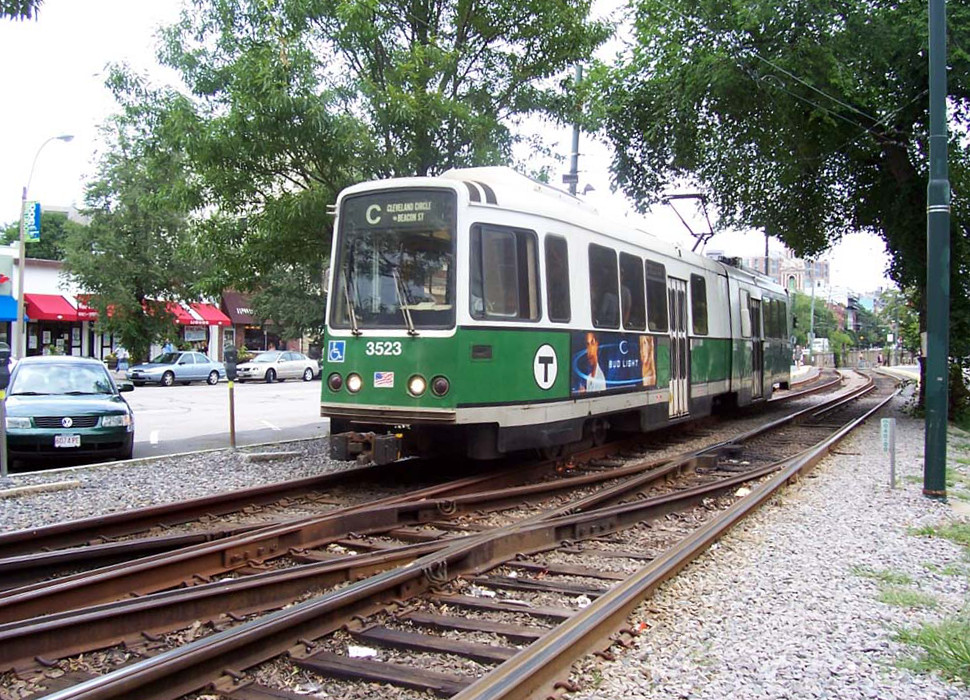
The Boeing standard LRV underwent extensive rebuilding by the MBTA, with the air conditioning unit relocated to the roof and the doors converted to folding doors, resulting in a significant improvement in reliability.
Copyright Information: Adam E. Moreira – CC BY-SA 3.0
For the MBTA, the impact was particularly severe. The new cars’ reliability was so poor, that instead of retiring the old PCC cars, the MBTA was forced to keep them around on life support. The MBTA at one point sidelined as many as 35 inoperable Boeing LRVs which were cannibalized for spare parts, and when a local newspaper broke the story that those cars had been hidden in an abandoned tunnel out of sight of the public, it turned into a major scandal.
It didn’t take long for the MBTA to run out of patience. On October 9, 1978, the MBTA formally refused acceptance of the remaining 40 cars on order, and the matter escalated into a legal dispute. The lawsuit dragged on for over a year, and payments to MBTA’s law firm swelled to several times the procurement cost of a new LRV, raising questions in the legislature. On November 19, 1979, Boeing and the MBTA finally reached a settlement: Boeing paid the MBTA a massive $40 million (about $255 million in 2026 dollars) in compensation, and the MBTA secured the right to reject the remaining cars on order. At the same time, all subsequent modifications became the MBTA’s responsibility, and the agency launched a much needed but costly rebuild program, with an emphasis on the doors and air-conditioning equipment. These new vehicles, born as symbols of standardization, in reality turned into bottomless money pits, with maintenance, repairs and modifications dragging on with no end.
Meanwhile, in San Francisco (MUNI), the Boeing Standard LRV was initially greeted with high expectations. In 1975, MUNI even redesigned its logo in anticipation of the new fleet, but delays in the program pushed the start of revenue service back to 1979. As with Boston, the reaction from crews and riders was far from favorable. The complex plug door and adjustable step arrangement incorporated to serve both the high-level platforms in the subway and the low-level platforms on the surface streets made the mechanism exceedingly complex, leading to frequent failures. In later years, converting the cars that MBTA had rejected into MUNI specs also involved a costly modification process.
Corrosion also became a serious issue in later years. Operating in coastal cities was already harsh enough, but matters were made far worse by the fact that the car bodies and trucks were shipped from Japan via the Panama Canal while exposed to the elements on the deck of cargo ships, and then stored outdoors near the Boeing plant while awaiting assembly. The Standard LRV project began with the weight of the world behind it, but both Boeing and UMTA had little experience with this kind of undertaking, and the gap between idealism and reality gradually became impossible to ignore.
Legacy of the Boeing Standard LRV
The Boeing Standard LRV, plagued by derailments, breakdowns, and lawsuits, eventually faded quietly from the spotlight. In San Francisco, MUNI replaced them with Breda LRVs and gradually retired the fleet between 1996 and 2001. In Boston, the MBTA kept the cars running through repeated rebuilds, but revenue service finally ended in 2007. Of the Boeing Standard LRVs that were built, only three made it into museums. MUNI car 1213 at the Oregon Electric Railway Museum and MUNI car 1258 at California’s Western Railway Museum have both been kept operational and still carry visitors on occasion. By contrast, MBTA car 3424, acquired by the Seashore Trolley Museum in 2009, appears to have reached the end of the line, and is preserved only as a static display.
As the track record suggests, the Boeing Standard LRV was far from a success. It was the product of an inexperienced team trying to realize an overly ambitious vision, only to run up against reality. In both Boston and San Francisco, older PCC cars remained in service long afterward. In Philadelphia, SEPTA withdrew from the project altogether and instead adopted much less technologically ambitious yet far more reliable LRVs built by Kawasaki Heavy Industries.
Even so, the Boeing LRV cannot be dismissed simply as a failure. The basic configuration required under the U.S. Standard LRV program—an articulated body, three trucks, and dual cabs—along with the specifications and dimensional standards created for this new generation of vehicles, helped form the foundation for many later light rail systems. Boston’s later Type 7 cars built by Kinki Sharyo, San Francisco’s Breda cars, and Siemens models such as the SD-100 and S70, can all be seen as successors built on groundwork the Boeing Standard LRV helped establish. Unlike the Boeing cars, which struggled to integrate with ancient and inconsistent infrastructure, later light rail systems benefited from standardizing track, stations, and other facilities built around modern LRVs.
The Boeing plant in Pennsylvania where final assembly took place was later used to assemble Kawasaki-built LRVs for Philadelphia’s SEPTA system. Tokyu Car, which manufactured the car bodies and truck frames, also seems to have carried lessons from the Boeing Standard LRV into later vehicles for the U.S. market. The challenges and lessons learned along the way were not in vain.
The impact of the US Standard LRV was felt around the globe. The idea of developing a next-generation streetcar through a centralized, standardized process later influenced the establishment of the Light Rail Vehicle Development Research Committee of the Japan Railway Engineers’ Association. The Hiroshima Electric Railway’s 3500 series cars, which emerged from that effort, incorporated many of the features of the Boeing Standard LRV, such as chopper control and inside-frame bogies. The U.S. Standard LRV then, should not be remembered simply as an embarrassing dead end. It was an ambitious but troubled vehicle that appeared at a turning point in American urban transit, and left a real mark on what followed. In searching for a post-PCC future, the Boeing Standard LRV embodied the trial-and-error process through which the modern American LRV gradually took shape.