
Local Assembly, International Friendship, and the Case for Preservation
The Airporter II was not a conventional export order. Tokyu Car could not simply design and build trains in Japan, ship them to Cleveland, and consider the project done. To win and execute the contract, the company had to navigate a challenging American public-procurement system that emphasized local employment, political accountability, public scrutiny and domestic supply chain rules. The Airporter II became a test case for Japanese railcar builders entering North America: technical competence alone was not enough. Success also required local assembly, American suppliers, political finesse, and productive relationships with the transit agency and the communities it serves.
Sanemitsu Toki, the Tokyu Car executive involved in sales and design coordination, who traveled repeatedly to Cleveland and became closely involved in the negotiations surrounding the Airporter II order, described the project’s difficulties in detail in his *Railfan* magazine series, “Memoirs of a Railcar Engineer.” He recalled how the GCRTA board imposed demanding conditions for the contract. The Board required final assembly to take place in the Cleveland area, the use of the Port of Cleveland, and for Cleveland-made or locally sourced components to be used wherever possible. These requirements reflected not only Buy America provisions and other public-procurement rules, but also the intense political priorities of American urban transit agencies. Toki recalled that some requirements proved impractical and were later set aside through informal discussions between Tokyu Car and GCRTA. He regarded that flexibility as strikingly different from the more rigid administrative process he knew in Japan.
While Tokyu Car could negotiate some local requirements with GCRTA, but federal Buy America requirements allowed far less flexibility. Rather than ship complete cars from Japan, Tokyu Car designed the vehicles and fabricated their bodies in Japan, sourced major components in the United States, and completed final assembly at a GE repair facility in the Cleveland area. The first four cars were completed in Japan, while the remaining 56 cars were shipped to the United States in partially completed form and finished in the Cleveland area.
This arrangement anticipated a model that later became common in North American railcar procurement: overseas engineering and fabrication combined with domestic sourcing and final assembly. It brought Japanese railcar design and manufacturing expertise to the United States while tying procurement, final assembly, and employment to the American local community.
The Airporter II was therefore a difficult but practical pioneer—an early model of what Japanese companies would need to do to enter the North American railcar market in earnest.
Mock-up reviews, structural load testing of the car bodies, and the many tests required of equipment built for the American market were all successfully carried out in Japan. Photographs taken by the editorial staff of *Railfan* magazine in December 1983 showed newly completed stainless steel cars at Tokyu Car’s factory, just before their journey across the Pacific. Completed cars began arriving in 1984, and, after testing, entered revenue service on the Red Line. For more than four decades, they carried passengers between downtown Cleveland and Cleveland Hopkins International Airport.
That long service life is itself a measure of the project’s success. It also explains why the fleet now faces the familiar consequences of age: corrosion, accident damage and declining parts availability. Some cars received mid-life overhauls while others were not so lucky, and as of 2026, the 20 cars that did not have all been retired. After being stripped of usable parts, they were dismantled and sorted by material for recycling.
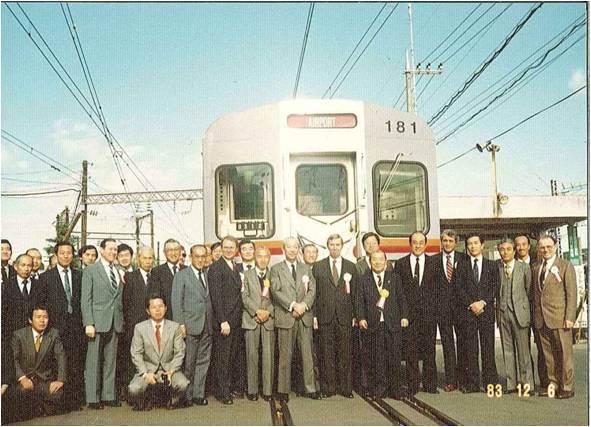
The first Airporter II – Completed at Tokyu Car Yokohama
©GCRTA – Public Domain
A Partnership Beyond the Contract
The Airporter II depended on more than contracts, specifications, and procurement rules. It also depended on the working relationship between Tokyu Car and GCRTA, particularly the close friendship that developed between Sanemitsu Toki and GCRTA Director of Rail Operations Ken Sislak.
Toki recalled that Sislak, with his background in business administration, possessed an unusually deep understanding of railcar technology. He made decisions quickly. While he put the needs of the GCRTA first, he was also understanding and cognizant of the needs of Tokyu Car as the manufacturer. Together, they considered what would be best for the delivery of the completed cars, the transit agency’s needs, and the project as a whole. Across national borders and the boundaries of business, they developed mutual respect as professionals.
Their relationship eventually extended beyond work. Interested in Japanese culture, especially Kabuki, Sislak invited Toki to his home for dinner; Toki later welcomed Sislak into his own home in Japan. The project had created a relationship that extended beyond the manufacturer and its customer to include both of their families.
One especially symbolic episode took place after deliveries commenced. When Sislak visited Japan, he asked Toki for an opportunity to personally thank the workers who built the trains. With the more than 1,000 employees at the Yokohama plant gathered, Toki introduced Sislak. Standing at the podium, Sislak thanked the factory workers in his own words for delivering such fine trains. For Toki, it was an experience unlike anything he had encountered, whether for a domestic customer or for an export project. For the workers who had built the Airporter II, the visit made the project tangible and meaningful. Their work was carrying passengers in a distant American city, and an executive of the agency traveled across the Pacific to thank them in person.
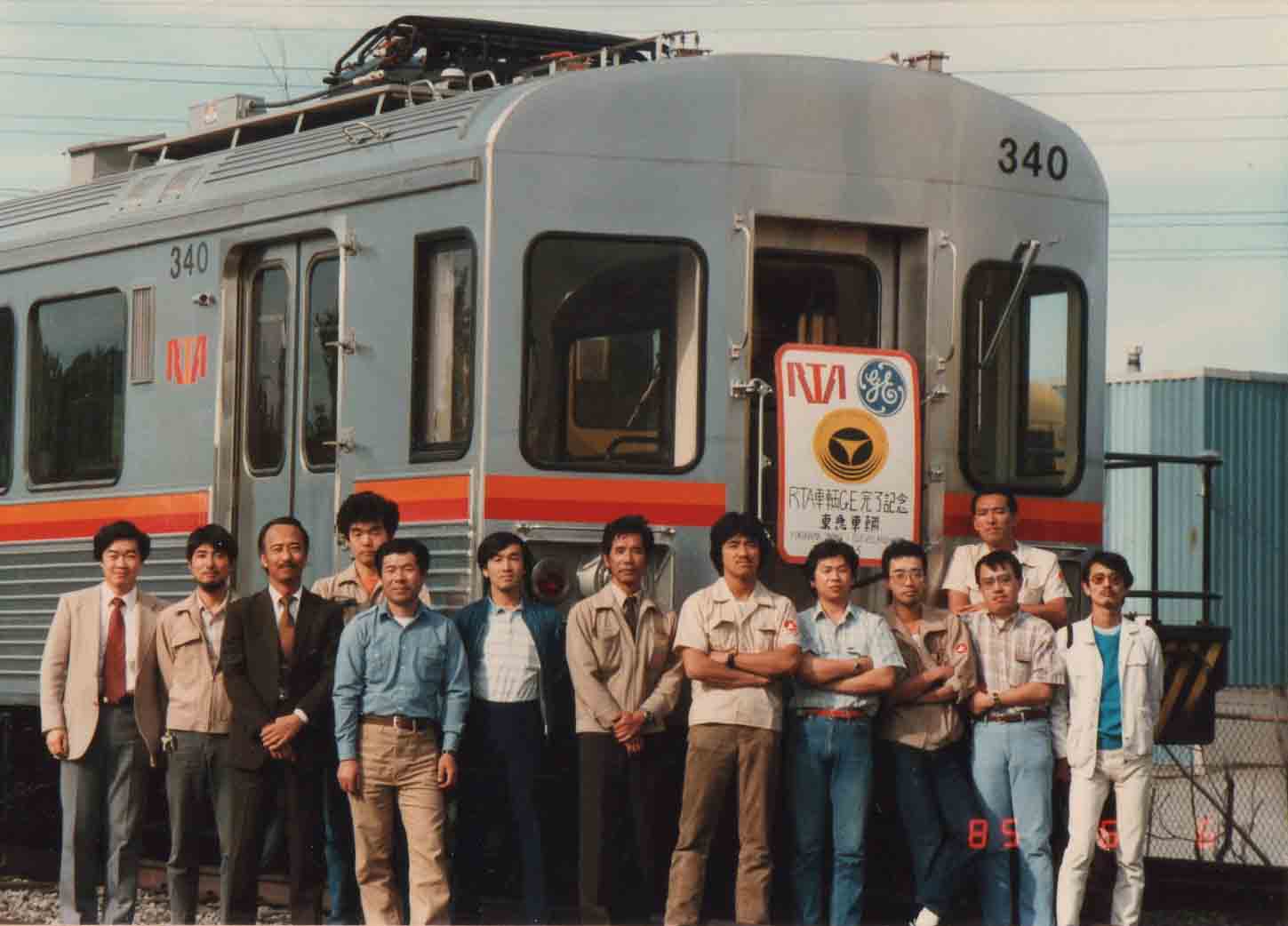
The final Airporter II, #340 Completed at GE Cleveland in 1985
©Ken Sislak – Used with Permission
Toki also wrote that after Sislak retired from GCRTA and moved to an insurance company, ending any remaining professional relationship, the two men continued exchanging Christmas cards every year. The thoughtfully written cards included not only personal news, but also kind words for Toki’s family.
After his retirement, Toki wrote a 22-part series for a magazine titled “Memoirs of a Railcar Engineer,” recording the history of postwar Japanese railcar engineering through stories of orders, design, manufacturing, testing, and overseas work. The series was later published as *Building Electric Trains* in 1994. While many of Toki’s articles focused mainly on railcar technology, business arrangements, and difficult projects, his Airporter II article gave unusual emphasis to his friendship with Sislak. Toki’s emphasis is revealing: in the six pages long article on the Airporter II, he mentioned Sislak by name 15 times. For Toki, the Airporter II was clearly more than another chapter in his career. It was one of the most defining professional experiences of his life.
The Difficult North American Market
The Airporter II was an important early success for Tokyu Car, but it did not make North America an easy or consistently profitable market for Japanese railcar builders. The Cleveland order showed that Japanese manufacturers could adapt their designs, production methods, and business practices to American requirements. It also showed that technical competence and a successful delivery record were only part of the equation.
Tokyu Car’s North American work soon extended beyond Cleveland. Its projects included earlier cooperation with Boeing for the Standard LRV, LRVs for Buffalo, M-4 EMUs for MTA Metro-North, and C-1 bilevel coaches for the MTA Long Island Rail Road. Together, these orders helped establish the company as one of several Japanese builders seeking a lasting position in the North American market.
Yet the market remained difficult. Orders were irregular, local assembly and domestic-content requirements added cost and complexity, and exchange-rate changes could quickly alter the economics of an export-based business. Tokyu Car eventually withdrew from North America, while its railcar-manufacturing business was transferred to JR East in 2012 and continues today as J-TREC.
Other Japanese manufacturers encountered similar headwinds. Nippon Sharyo, once considered an industry giant in North America, also struggled with major contracts and closed its Rochelle, Illinois plant in 2018. These experiences demonstrated that engineering prowess and past success do not necessarily ensure long-term commercial stability.
Japanese companies nevertheless continue to fight the good fight in the market. Kawasaki has supplied Washington Metro’s 7000-series fleet and has received an order for New York City Subway R268 cars. Hitachi Rail has shown recent success in Honolulu and WMATA, while Kinki Sharyo has taken part in the final assembly of subway cars for Los Angeles.
North America remains a demanding market in which local production, procurement rules, political considerations, quality assurance, contract terms, and long-term maintenance obligations all matter. In that context, Cleveland’s Airporter II stands as both an early achievement and a reminder of the continuing difficulty of establishing a durable foothold in the North American railcar industry.
The Case for Preservation
The Airporter II’s long service life is now nearing its end. After more than 40 years connecting Cleveland and its airport, these cars are about to change roles from active transportation equipment to historical artifacts.
Under GCRTA’s replacement program, new Siemens LRVs are expected to enter Red Line service in August 2027. The Tokyu Car-built Airporter II fleet is expected to be withdrawn around the same time. As the new railcars are introduced, Red Line stations will be modified and the route’s structure and loading-clearance standards will be revised. Once these permanent changes are completed, the Airporter II cars, which do not conform to the new standards, will never again be able to operate on the GCRTA Red Line.
That is precisely why preserving one of these trains matters. Few railcars in history represent so much: the transfer of stainless-steel technology from Budd to Tokyu, Japanese entry into the North American market, Cleveland’s airport-transit history, and the personal relationships that made an international project come together. If every Airporter II is scrapped, Cleveland will lose more than a historical icon. It will lose a physical link to the engineers who negotiated the order, the workers who assembled the cars, the passengers who relied on them, and the international bond and friendship that formed.
JATHO—the Japan-America Transportation History Organization—is developing a museum plan focused on the transportation history linking Japan and the United States. Our proposed collection includes rail vehicles and light aircraft, with an emphasis on interpreting not only the artifacts themselves but also the trans-pacific relationships and technological exchanges behind them. Within that framework, an Airporter II is identified as a core exhibit.
The Airporter II was more than a Japanese-built train sold to an American transit agency. Its stainless steel technology descended from Budd, its design reflected Tokyu Car’s Japanese experience, its final assembly and many major components were American, and its service life became part of Cleveland’s own airport-transit history. Preserving one car would preserve a tangible record of that shared story: not only a distinctive railcar, but also the industrial knowledge, international cooperation, and personal trust that brought it into existence.
The end of service in 2027 should mark not only the end of revenue service on the Red Line, but the beginning of the Airporter II’s next life as an artifact of trans-Pacific transportation history.